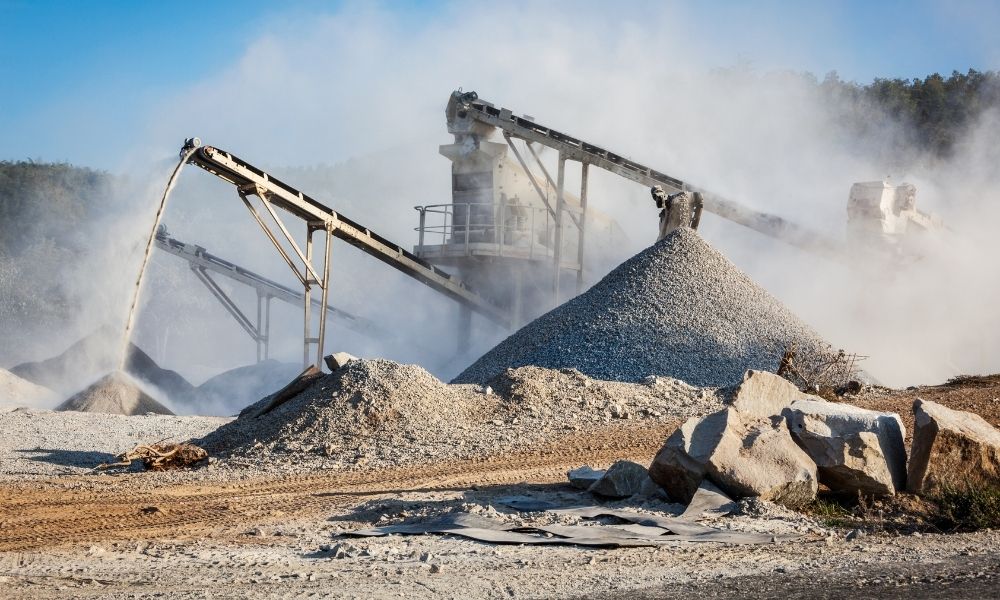
In nearly every construction, mining, or aggregate operation, rock crushers play a crucial yet often overlooked role. These machines are responsible for reducing large, heavy rocks into manageable pieces that can be used in a variety of industrial operations. From building highways and bridges to mining minerals and recycling concrete, rock crushers form the foundation of countless industries. Many contractors opt for concrete crusher rental services to handle short-term projects efficiently, giving them access to powerful on-site crushing equipment without the long-term investment costs of ownership. Understanding how they work, the different types available, and where they’re used helps reveal just how essential these machines are to modern infrastructure and production.
What Is A Rock Crusher?
An apparatus used to break huge boulders into smaller pieces or fine particles by applying mechanical force is called a rock crusher. These smaller pieces are used in construction, road building, landscaping, and manufacturing processes. Crushers are typically categorized by the method they use to reduce material — compression, impact, or shear.
Modern crushers are equipped with smart control systems, hydraulic adjustments, and advanced safety features that make them far more efficient, reliable, and environmentally friendly than their early predecessors.
Types Of Rock Crushers
Each type of rock crusher serves a specific purpose, depending on the hardness, size, and desired end product of the material. Here are the main types:
- Jaw Crushers
Primary crushing is frequently accomplished with jaw crushers. They feature two plates — one stationary and one movable — that compress rock until it breaks. They are perfect for hard materials like granite, basalt, and concrete because of their strength and ease of use.
- Cone Crushers
Cone crushers use a rotating cone inside a stationary bowl to crush material through compression. Usually employed for secondary or tertiary crushing, they yield homogeneous, finely formed aggregates that are ideal for the manufacturing of concrete and asphalt.
- Impact Crushers
Impact crushers use rapid blows from high-speed rotating hammers or bars to shatter material. These are highly effective for softer rocks or recycling applications, producing a consistent product size with excellent cubic shape.
- Gyratory Crushers
Gyratory crushers operate similarly to jaw crushers but handle larger capacities. Their conical design makes them efficient for large-scale mining and quarrying operations.
- Vertical Shaft Impact (VSI) Crushers
These machines use centrifugal force to propel material against a hard surface, creating fine, precisely shaped particles. They are commonly used in sand making and fine aggregate production.
Industrial Applications Of Rock Crushers
Rock crushers are integral to multiple industries that rely on processed stone and aggregates for daily operations.
- Construction And Infrastructure: Crushed rock is a core ingredient in concrete, asphalt, and road base materials. Every road, building foundation, and bridge relies on properly sized aggregate.
- Mining And Mineral Extraction: In mining, crushers reduce ore size for easier handling and processing, helping extract valuable minerals like gold, copper, and iron.
- Recycling And The Management Of Waste: Crushers play a major role in recycling concrete and asphalt, turning demolition waste into reusable aggregate — an eco-friendly alternative that conserves natural resources.
- Agriculture And Landscaping: Smaller rock crushers help process limestone and gravel for soil conditioning, decorative pathways, and erosion control.
For contractors seeking convenient access to crushing solutions, mobile and portable units now make it easy to find a rock crusher near me, allowing on-site crushing for maximum efficiency and reduced transportation costs.
Choosing The Right Crusher
Selecting the correct rock crusher depends on factors such as material hardness, required output size, and production goals. Jaw crushers excel in durability and coarse reduction, while cone and VSI crushers deliver precision for finishing stages. Many operations combine multiple types to achieve optimal results across various stages of crushing.
Final Thoughts
Rock crushers are far more than industrial machines — they are the backbone of progress in construction, mining, and recycling. By converting raw materials into usable resources, they make it possible to build roads, cities, and industries that power the modern world. As technology continues to advance, rock crushers will only become more efficient, adaptable, and sustainable — continuing to turn nature’s hardest materials into the building blocks of human achievement.